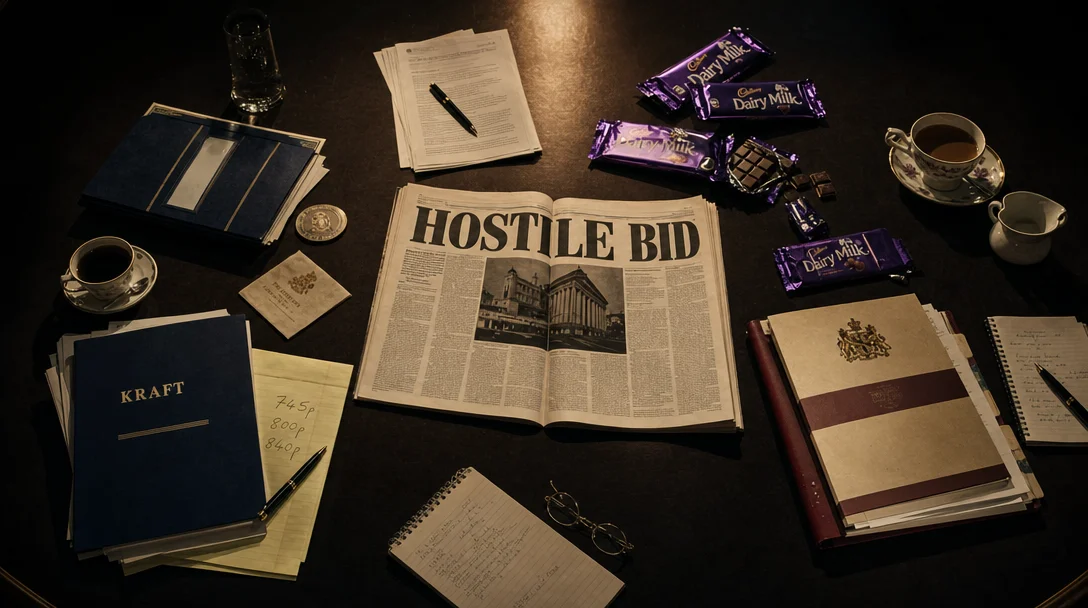

The chocolate war: how Kraft broke every rule — and still won

The chocolate war: how Kraft broke every rule — and still won

In August 2009, Kraft Foods CEO Irene Rosenfeld flew to London, made a 20-minute pitch to Cadbury chairman Roger Carr, and was rejected. What followed was 17 months of hostile bid mechanics, phantom white knights, parliamentary spectacle, and a single broken factory pledge that rewrote British takeover law. Kraft paid £11.9 billion — £1.7 billion more than its opening ask — for a deal its largest shareholder publicly condemned, yet the case's lasting lesson isn't about the price: it's about how an arb-heavy shareholder register made the board's defense narratively brilliant and structurally irrelevant, and how an eight-word sentence about a Bristol chocolate factory triggered the most comprehensive reform of the UK Takeover Code in a generation.

Business Negotiation Classics: One Case a Day
2026. 6. 4. · 21:28
구독 1개 · 콘텐츠 3개
On August 28, 2009, Irene Rosenfeld flew to London and sat down with Roger Carr, the chairman of Cadbury, at the Centrica offices where Carr also held a chairmanship. She made a 20-minute presentation. He listened, said no, and called Kraft "a low-growth conglomerate." 1 Rosenfeld flew home and prepared to go public.
What followed was 17 months of hostile bid, parliamentary spectacle, phantom white knights, and a single broken factory promise that ended up rewriting British takeover law. Kraft eventually paid £11.9 billion£1.7 billion more than its opening ask — for a deal its largest shareholder publicly called "a bad deal" on the day the target's board recommended it. 2 And yet Kraft got broadly what it wanted: the world's second-largest confectionery business, a meaningful emerging-market footprint, and a brand with 135 years of British heritage that Rosenfeld could not have assembled from scratch in any timeframe.
This case is instructive not because Kraft negotiated brilliantly — its public credibility collapsed within a week of closing — but because of what the deal reveals about the mechanics of hostile-to-friendly conversion, the irrelevance of public opinion in UK takeover law, and the long tail of a broken promise.

The parties, what they said they wanted, and what they actually wanted

Kraft Foods (bidder)Cadbury (target)Hershey / Ferrero (phantom bidders)
Stated objectiveAcquire a "formidable global powerhouse in snacks, confectionery and quick meals" 3Remain independent; if sold, at a price reflecting "true value"Express interest; preserve optionality
Hidden preferencePay no more than 13× EBITDA; use stock (not cash) to conserve balance sheetFind a white knight or force Kraft above 850p; keep senior management in placeNeither had the financing or governance alignment to actually bid
BATNAWalk away and cede growth in emerging markets; face shareholder pressure on standalone strategyRemain independent — credible only if a rival bidder emergedHershey: constrained by the Hershey Trust's dual-authority structure; Ferrero: no large-deal track record
Key leverage£9.2 billion bridge loan secured at launch; willingness to go hostile and endure public condemnation135-year Quaker heritage; genuine growth outperformance vs. Kraft (revenue growth 50% faster, 2004–2008) 4Hershey's public announcement of "reviewing options" created temporary competitive pressure; neither could deliver
Hidden asymmetryKraft knew arbitrageurs were accumulating Cadbury shares — ~30% of Cadbury's register would be held by hedge funds and merger arb desks by the final negotiation, all with a short investment horizon 5The board was nominally defending independence, but Franklin Templeton (7% stake) had already signaled at 830p that it would accept — the management team had less control over the outcome than its public posture impliedTheir phantom status actually helped Kraft: it forced Cadbury to mobilize a defense budget and emotional energy against threats that would never materialize

Five turns of the screw

Turn 1: Anchor low, go hostile (September 2009)

Kraft's opening bid of 745p per share — 300p cash plus 0.2589 Kraft shares — valued Cadbury at approximately £10.2 billion. 3 The day the bid was announced, Cadbury's stock jumped 41 percent to 802p — already above Kraft's stated offer — and every analyst in the market said Kraft would need to raise. Charles Stanley's Jeremy Batstone-Carr estimated the real clearing price at 800p in cash or higher.
Carr's public rejection was withering: "Kraft's offer does not come remotely close to reflecting the true value of our company and involves the unattractive prospect of the absorption of Cadbury into a low-growth conglomerate business model." 1
The bid's opening low anchor was not a mistake. Kraft needed a floor price in the public record. Every subsequent penny-per-share increase would be framed as a concession Cadbury extracted — but the starting reference point was Kraft's, not the market's.
Meanwhile, Warren Buffett — whose Berkshire Hathaway held 9.4% of Kraft shares — went on CNBC on September 16 to deliver a very public constraint: "Anytime you're in a takeover, you know, the animal spirits run high and all of that. But Kraft has the disadvantage of using an undervalued stock." 6 Nine days later, Rosenfeld addressed a global employee gathering and promised: "I can assure you we will avoid allowing those animal instincts that Warren Buffett alluded to take over." 6 The Buffett constraint mattered. Kraft's final deal structure — more cash, fewer new shares — was partly designed to neutralize his objection.

Turn 2: The formal hostile launch and the "derisory" counter (November 2009)

On November 9, 2009, Kraft filed its formal hostile bid — the Takeover Panel's "put up or shut up" (PUSU) deadline forced the move. By then Kraft's own stock had slid, so the effective value of the offer had fallen from 745p to roughly 717p. 7 Kraft simultaneously secured a $9.2 billion bridge loan from Citigroup, Deutsche Bank, and HSBC to signal financing capacity. 8
Carr's response was immediate: "The board has emphatically rejected this derisory offer and has strengthened its resolve to ensure the true value of Cadbury is fully understood by all." 9
A £11.9bn price tag was placed on a company whose most iconic product retails for under £2. 9
The same week, Hershey confirmed it was "reviewing its options" and Ferrero announced it was in "preliminary stages of evaluating its options." 10 Neither company had the structural capacity to actually bid. Hershey was governed by the Hershey Trust, whose two effective principals had a well-documented history of disagreement on major moves. Ferrero was a family-controlled business with no large-acquisition track record. Both withdrew by January 22, 2010 — Ferrero on January 12, Hershey ten days later — without ever filing a competing offer. 1
Their inability to bid mattered because it was not fully visible to the market in real time. Cadbury's board spent months defending against threats that were never credible, while the arb community steadily accumulated the shares that would decide the outcome.

Turn 3: Cadbury's 24-page defense — and the pizza that funded the purchase (December 2009 – January 2010)

On December 14, 2009, Cadbury published a 24-page defense document. Carr's message was direct: "Don't let Kraft steal your company. Cadbury has both a heritage and a future that has to be paid for. The Kraft offer ignores the past, undervalues the present and is blind to the future." 11 Cadbury raised its long-term sales growth target from 4–6% to 5–7% and promised double-digit dividend increases. CEO Todd Stitzer took the roadshow to US institutional investors personally.
On January 5, 2010, Kraft sold its North American frozen pizza business — DiGiorno, Tombstone, Jack's — to Nestlé for approximately $3.7 billion in cash. The deal did two things simultaneously: it gave Kraft the firepower to raise its cash component (directly addressing Buffett's objection to stock dilution), and it removed Nestlé from the potential white-knight pool. 12 Buffett later complained the sale was "enormously tax-inefficient" — he calculated the after-tax proceeds at $2.5 billion, not $3.7 billion — but the strategic logic was clear even to the deal's critics. 2
On January 12, 2010, Cadbury filed its final defense document, attacking Kraft's management record directly: Kraft's stock had underperformed global peers by 42% since its New York listing; its operating profit had grown at a rate that Cadbury's finance team characterized as essentially flat versus Cadbury's 31% gain over the same period. Carr concluded: "Kraft's track record does not fill you with confidence; they have promised much but delivered less." 4 That same day, Ferrero officially withdrew.
The defense was rhetorically strong. The problem was the shareholder register. By mid-January, hedge funds and merger arbitrageurs held an estimated 30% of Cadbury's shares. 5 These investors had bought at prices above Kraft's initial offer, expecting a deal to happen. They needed an exit. The board could defend all it wanted; the register had already moved past them.

Turn 4: The Lanesborough Hotel and the overnight deal (January 18–19, 2010)

On Sunday, January 17, Rosenfeld called Carr and proposed 830p. Carr said no. He had board authorization to hold at "850p or nothing." 13
The following morning, the two principals met at the Lanesborough Hotel on Hyde Park Corner. Rosenfeld proposed 840p. Carr called it insufficient; the formal board mandate was 850p. The meeting ended without a deal — but the gap was now 10 pence, and both sides' advisers understood that the math was closeable.
That night, teams from Lazard, Citi, Deutsche Bank, and Centerview (Kraft) and Goldman Sachs, Morgan Stanley, and UBS (Cadbury) worked through the night at Lazard's London offices. The solution that emerged was arithmetically ingenious: Kraft would pay 840p per share (500p cash plus 0.1874 Kraft shares) plus a 10p special dividend, bringing the total consideration to 850p — exactly Cadbury's stated threshold, technically met by a mechanism that preserved Kraft's reported acquisition price at the lower headline figure. 13
A participant later told Reuters: "If she lost because of 10 pence it would kill her, but if she overpaid by 10 pence, would anyone really pay that much attention?" 1
The Cadbury board unanimously recommended on January 19, 2010. The deciding vote had arguably been cast the previous week: Franklin Templeton, with 7% of Cadbury's shares, had signaled it would accept at 830p. Once the arb-heavy register signaled willingness at sub-840p, Carr's 850p mandate was aspirational rather than binding. The £11.9 billion total consideration was the largest European food-and-drink deal on record at the time. 14
Carr told BBC Radio that morning: "This is a bitter-sweet moment. As a chairman of a public company you are paid and required to focus on shareholder value and the process which we have undertaken has delivered shareholder value." 13 The headline on Buffett's reaction the following day was different: "I felt poor." 2

Turn 5: The seven-day betrayal (February 2–9, 2010)

The offer went unconditional on February 2, 2010. The deal closed on February 5. Carr, Stitzer, and CFO Andrew Bonfield all resigned the same day. Seven days later — on February 9 — Kraft announced it would close the Somerdale factory in Keynsham, near Bristol.
During the bid process, Kraft had written in its formal offer document that it "believed we should be in a position to continue to operate the Somerdale facility." 15 That statement was now reversed. Rosenfeld explained: "In our recent talks with Cadbury senior management, it became clear that it is unrealistic to reverse the closure programme, despite our original intent to do so." 16
The explanation was technically defensible: Cadbury had been running a "parallel operation," spending over £100 million transferring production to a new facility in Skarbimierz, Poland, while Somerdale remained open. By the time Kraft took ownership, specialist equipment — including the dedicated Curly Wurly production line — had already been dismantled and shipped east. Reversing the programme was genuinely impractical.
The Somerdale factory employed over 400 workers at the time of its closure. The broken pledge directly triggered a rewrite of UK takeover law. 17
The political response was immediate and severe. Unite General Secretary Jennie Formby accused Kraft of making a pledge while "deliberately mislead[ing] many hundreds of decent men and women." Lord Mandelson, then Business Secretary, said Kraft should have been "more straightforward and straight dealing" given that a week before the announcement Rosenfeld "would have known what announcement would be made." 18
On March 16, 2010, Kraft EVP Marc Firestone appeared before the House of Commons Business, Innovation and Skills (BIS) Select Committee. Rosenfeld had declined to attend in person. Firestone's appearance was, by most accounts, painful. Labour MP Roger Berry asked whether Kraft had "Googled it" with respect to the Somerdale facility. Firestone answered that Kraft had in fact run a Google search — and had satellite images of the exterior — but had not been aware of the £100 million investment in bespoke equipment inside the building because the site was "physically secured" and access had been refused. 18
Labour MP Lindsay Hoyle arrived carrying a Terry's Chocolate Orange and pointed out that Kraft had done the same thing to the York confectionery business years earlier. Firestone apologized three times, including "terribly sorry" and "terribly disappointed." 19
On April 6, the BIS Committee published its formal report. The verdict: Kraft "acted both irresponsibly and unwisely in making its original statement that it believed that it could keep the Somerdale factory open. A company of Kraft's size and experience ought simply to have acted with better judgement." The committee said Kraft was open to the charge of either incompetence or "a 'cynical ploy' to cast a positive light on Kraft during its takeover of Cadbury." 20
One footnote: the same month the committee report was published, SEC filings disclosed that Rosenfeld's 2009 total compensation was $26.3 million — a 41% increase over 2008, which Kraft's compensation committee attributed to "the significant effort and the ultimate acquisition of Cadbury." 21 The juxtaposition with Somerdale workers losing their jobs became a recurring motif in British press coverage for the rest of that year.

The "Cadbury Rules": how one broken promise rewrote UK law

On May 26, 2010, the UK Takeover Panel issued Panel Statement 2010/14 — a formal public criticism of Kraft Foods for breach of Rule 19.1 of the UK Takeover Code (standards of care). The Panel concluded Kraft "did not have a reasonable basis" for making the Somerdale statement when it did, and had failed to investigate the facility's transition status adequately before committing publicly. 22 It was the Panel's first public censure in three years.
The criticism triggered a formal consultation. In June 2010, the Panel's Code Committee published PCP 2010/2, opening a review of "certain aspects of the regulation of takeover bids." The Committee had concluded that "hostile offerors have, in recent times, been able to obtain a tactical advantage over offeree companies to the detriment of the offeree company and its shareholders." 23
The revised UK Takeover Code took effect on September 19, 2011 — 20 months after the Somerdale reversal. The core changes, which practitioners quickly labeled the "Cadbury Rules," included:
  • New Rule 2.6: Once publicly named, a potential bidder has an automatic 28-day deadline to announce a firm offer or walk away. Previously, the target board had to actively request such a deadline from the Panel — a step widely seen as self-serving. Extension requires target-board consent and Panel approval; the bidder cannot unilaterally extend. 24
  • New Rule 21.2: A general prohibition on "offer-related arrangements" — break fees, matching rights, "no shop" clauses, "no talk" clauses — all standard deal-protection devices in US M&A practice. Limited exceptions exist for white knights and targets in financial distress; where break fees are permitted, they are capped at 1% of offer value. 22
  • Rules 19.6–19.8: Bidder statements about employees, business locations, and fixed assets made during an offer period are binding for a minimum of 12 months post-acquisition. Failure to adhere may result in Panel disciplinary action. 23
Slaughter and May's Nigel Boardman, who led the XBMA practitioner analysis, framed the shift this way: the reforms "aim to strengthen the position of UK target companies in bid situations. Bidders will face additional challenges, having to ensure confidentiality pre-announcement, organise funding and regulatory arrangements swiftly, adapt to the reduction in deal protection measures and follow through on statements of intent." 22
The European Commission had already cleared the deal — six weeks before Cadbury's board recommended it — via a Phase 1 clearance under EU Merger Regulation Case COMP/M.5644. The conditions required two divestitures: Cadbury's Wedel chocolate business in Poland (including manufacturing sites in Warsaw and Bielany Wrocławskie) and the Kandia confectionery business in Romania (including the Kandia, ROM, and Laura brands). Kraft was barred from reacquiring either business for 10 years. 25
링크 미리보기를 불러오는 중…

Frameworks you can use

Premium escalation and the arb register problem

Research by David Becher (Drexel University) and Thomas Bates (Arizona State University) on contested takeovers shows that over half of target companies receive at least one follow-on bid, and the raw premium across contested deals runs on average 22 percentage points higher than in uncontested ones. 5 The Kraft-Cadbury deal confirms the pattern: Kraft's opening 31% premium became a final 50% premium, with a 14% nominal increase from 745p to 840p — but the more important variable was register composition, not bid price.
The practical mechanic works like this: when a hostile bid is announced at a credible but below-market premium, merger arbitrageurs and event-driven funds begin buying from long-term holders who want to exit uncertainty. By the time the board is fielding final offers, a substantial share of the register has turned over to investors whose holding cost is above the initial bid price and whose investment thesis is that a deal closes. These shareholders are structurally indifferent to the defense narrative — they need a deal exit, not an independence story.
Cadbury's board realized this late. When Becher's research describes "managers that initially resist a contested offer" typically receiving a significant follow-on premium, 5 it is describing a structural dynamic, not individual negotiating skill. The 30% arb concentration by mid-January 2010 was the mechanism through which Cadbury's board lost control of its own shareholder vote — not because it negotiated poorly, but because the register had migrated away from it.
Application: If you are advising a target board in a hostile situation, track register turnover alongside bid price. A board that wins the rhetoric war but loses 30% of its shares to short-duration holders has not won anything meaningful. Conversely, if you are a hostile bidder, a bid anchored well below the consensus "fair value" will attract arb buying that over time shifts your counterparty from a board with fiduciary independence to a register with a short time horizon.

The "put up or shut up" mechanism as negotiation-forcing device

The UK Takeover Code's Rule 2.4(b) (pre-2011) allowed a target company to request that the Panel impose a "put up or shut up" deadline on a named bidder. But as CMS Law noted at the time, target boards were "often reluctant" to invoke the rule because doing so "might be perceived to be self-serving or defensive." 26 The result: a bidder could maintain an indefinite "virtual bid" state — holding a target under siege without having to commit — while the target's management was distracted, its partnerships were at risk, and its employees were living under uncertainty.
Cadbury's situation during the three-month "put up or shut up" window illustrated all three costs. Kraft had publicly announced its approach and was technically in an offer period from September 7, 2009 onward. Cadbury's board had to maintain a full-time defense structure for months before the formal bid.
The 2011 reform made the 28-day deadline automatic — targets no longer need to request it. Once a bidder is publicly named, the clock runs regardless of either party's preference. Crucially, only the target board can request an extension, and Panel approval is also required. A bidder that needs more time must convince the target, not the regulator.
As Fox Williams observed after the first cohort of post-reform deals, "the playing field has changed in favour of the target board, since only the target can seek an extension to the deadline, a useful weapon in a hostile takeover situation." 24
Application: In any negotiation where one party has the option of maintaining ambiguity indefinitely (an unsolicited acquirer, a potential partner who has "expressed interest" without committing, a distributor evaluating an exclusive), the other party should set an explicit deadline as a structural device — not as a power play, but as an ambiguity-resolution mechanism. The Cadbury case shows that when the target cannot or will not set a clock, the cost falls almost entirely on the target. Post-2011, UK law does it automatically. In commercial negotiations without that legal backstop, you have to build the clock yourself.

The post-acquisition credibility trap

Kraft's Somerdale statement was not a lie in any simple sense. The UK Takeover Panel's own conclusion acknowledged that Kraft held "an honest and genuine belief" at the time of the statement that it could keep the facility open. 17 The problem was that Kraft made a public commitment about operational continuity without doing the operational due diligence to back it up. Cadbury's Somerdale transition was not a secret — it was ongoing, physical, and expensive — but Kraft had not been granted access to the site before the deal closed, and management had apparently decided that satellite images of the exterior were sufficient investigation.
The result is what can be called a post-acquisition credibility trap: a statement made during the heat of a contested bid (when the implicit goal is to reduce opposition) creates a commitment that the acquiring organization is structurally unable to honor after deal completion. The commitment is credible enough to win goodwill during the bid, but false enough to generate a severe reputational penalty once the truth emerges.
The mechanics of this trap are distinct from ordinary due diligence failure. Kraft's investment bankers had done extensive financial analysis of Cadbury. The Somerdale error was a failure of operational verification on a politically sensitive commitment made in a context where political sensitivity — rather than operational accuracy — was the dominant concern.
The 2011 regulatory response — binding bidder statements for 12 months — addresses the problem at the commitment stage rather than the due diligence stage: if you say it, you must be prepared to do it for a year. This changes the bidder's incentive structure from "say what works for the bid" to "say only what you can actually deliver."
Application: In any transaction involving specific operational commitments — to employees, customers, regulators, or communities — treat those commitments as binding contracts from the moment they are spoken publicly, not from the moment a deal closes. Kraft's lawyers can probably argue that the Somerdale statement was technically a "belief" rather than a "promise." That distinction saved them no reputational damage and produced a parliamentary hearing, a regulatory censure, and a rewrite of British law. The more useful rule: if you would not put the statement in the signed purchase agreement, do not put it in the offer document.
Somerdale workers outside Parliament on the day Kraft executive Marc Firestone testified before the BIS Select Committee. 18

Cross-border regime arbitrage: UK vs. US takeover architecture

Kraft's hostile bid succeeded partly because the UK system was structurally more permissive for an aggressive acquirer than the US system that Kraft's own advisers were accustomed to. The key asymmetry, documented in detail by Stephen Cooke of Slaughter and May, is board power: in the UK, "the Target Board is not the gatekeeper for offers. A Bidder may take its offer direct to shareholders and the Board has no power to block or delay an offer as it generally can in the US." 27
In the United States, target boards routinely use poison pills (rights plans), staggered boards, and other structural defenses that can delay or block a hostile bid indefinitely. In the UK, none of those mechanisms are available. The Takeover Code "embodies the pre-eminence of shareholders" — the board advises, but it cannot decide. A UK board's only real defensive tools are the quality of its defense narrative and its ability to find a credible competing bidder.
Cadbury's board did both exceptionally well by conventional measures: Carr's public communications were superb, the financial defense documents were rigorous, and Stitzer's US roadshow moved opinion among institutional holders. None of it mattered, because the arb community's economic logic was not responsive to narrative.
The post-2011 reforms partially rebalanced this picture by prohibiting the deal-protection measures that gave US-style acquirers a structural advantage once a deal was agreed. Before the reforms, Kraft could in principle have extracted a break fee, a no-shop clause, and matching rights from Cadbury as part of a recommended deal — making a competing bid more expensive and less likely. The new Rule 21.2 prohibits all of those mechanisms.
Application: When evaluating a cross-border M&A target, map the target's jurisdiction's takeover architecture before setting strategy. An acquirer used to board-gatekeeper dynamics (as US buyers typically are) should not assume that the target's board can be "flipped" once per the acquirer's schedule. In the UK, the timeline is controlled by the Panel and the PUSU clock — not by the board's willingness to engage. Conversely, a UK target board facing a US acquirer should understand that the acquirer is likely less familiar with operating in a regime where its normal deal-protection toolkit is unavailable.

What to remember

  • The register is your real counterparty, not the board. Cadbury's board issued an exemplary defense — public, rigorous, and emotionally resonant. It did not determine the outcome. By mid-January 2010, approximately 30% of Cadbury's shares were held by arbitrageurs and event-driven funds who needed a deal exit. No amount of heritage narrative or standalone-value argument moves shareholders whose investment thesis depends on a transaction closing. Track register composition alongside bid price from day one.
  • A commitment made in an offer document is a binding contract in everything but name. Kraft's Somerdale statement was technically a statement of "belief," not a promise. That distinction earned the company a parliamentary censure, a Takeover Panel rebuke, and a rewrite of British takeover law, while doing nothing to keep the factory open or protect its reputation. In hostile cross-border deals, operational commitments made to reduce opposition — on jobs, sites, brands, pensions — will be held to full contractual standard by regulators, legislators, and the press, even if a lawyer can argue they were not technically binding. If you cannot confirm the commitment through operational due diligence, do not make it.
  • The "put up or shut up" clock is the most useful single device in hostile deal-making. Before 2011, a bidder could maintain indefinite "virtual bid" pressure on a UK target without committing — a siege that cost the target management distraction, employee uncertainty, and shareholder instability while costing the bidder very little. The 2011 reforms made the 28-day clock automatic and removed the bidder's ability to extend unilaterally. In commercial negotiations that lack a regulatory clock, the party that benefits from ambiguity is almost always the potential buyer. Build your own deadline mechanism explicitly, before the ambiguity starts accruing costs.
  • Cross-border regulatory asymmetry is a strategic variable, not just a compliance item. Kraft, as a US corporate, was accustomed to a takeover environment where the target board has real defensive power. In the UK, the board's only tools are narrative quality and white-knight sourcing. That asymmetry made the deal easier for Kraft to execute — and made the 2011 regulatory backlash almost inevitable, since the UK public and Parliament perceived the outcome as structurally unfair to a target that had defended itself visibly and forcefully. When operating across jurisdictions, model what the losing party will do after the deal closes, not just what the target board can do during the bid.
Cover image: Irene Rosenfeld, Kraft Foods chairman and CEO, photographed by John Gress for Reuters. 21

참고 출처

  1. 1Reuters: How Kraft's CEO melted opposition to a Cadbury deal
  2. 2Guardian: Warren Buffett blasts Kraft's takeover of Cadbury
  3. 3NYT DealBook: Kraft to Pursue Cadbury, Even After Rejection
  4. 4Guardian: Cadbury attacks track record of Kraft bosses
  5. 5Drexel University LeBow: M&A research helps explain significance of Kraft-Cadbury deal
  6. 6CNBC: Kraft CEO heeds Warren Buffett's 'Animal Spirits' warning
  7. 7Reuters: Kraft turns hostile in $16 billion bid for Cadbury
  8. 8SEC EDGAR: Kraft Foods Amendment No. 4 to Schedule TO
  9. 9Guardian: Cadbury rejects £9.8bn hostile bid from Kraft
  10. 10Guardian: Hershey and Ferrero confirm bid interest in Cadbury
  11. 11Guardian: Cadbury steps up defence against Kraft
  12. 12Guardian: Timeline: Cadbury's fight against Kraft
  13. 13Reuters: Kraft snares Cadbury for $19.6 billion
  14. 14Guardian: Cadbury's board agrees £12bn sale to Kraft
  15. 15Reuters: British MPs slam Kraft over Cadbury plant closure
  16. 16The Independent: Kraft reverses pledge to keep Cadbury factory open
  17. 17Guardian: Kraft rebuked for broken pledge on Cadbury factory
  18. 18UK Parliament BIS Select Committee: Mergers, acquisitions and takeovers — the takeover of Cadbury by Kraft
  19. 19Guardian: Kraft promises MPs: no job cuts in UK
  20. 20UK Parliament BIS Select Committee: Conclusions and recommendations
  21. 21Guardian: Cadbury takeover earns Kraft's Irene Rosenfeld a 40% rise
  22. 22XBMA / Slaughter and May: UK UPDATE — Changes adopted to UK takeover regime
  23. 23The Takeover Panel: RS 2011/1 (July 21, 2011)
  24. 24Fox Williams: The impact so far of the takeover code
  25. 25European Commission: Case COMP/M.5644 — Kraft Foods / Cadbury
  26. 26CMS Law: Balance of power to be shifted towards takeover targets
  27. 27Harvard Law School Forum on Corporate Governance: 10 surprises for a US bidder on a UK takeover

이 콘텐츠를 둘러싼 관점이나 맥락을 계속 보강해 보세요.

  • 로그인하면 댓글을 작성할 수 있습니다.